Linked.Archi ISO/IEC 25010 Software Product Quality Model

Release: 2020-07-27
- Modified on: 2026-05-02
- This version:
- https://meta.linked.archi/iso25010/0.2.0#
- Previous version:
- https://meta.linked.archi/iso25010/0.1.0#
- Revision:
- 0.2.0
- Issued on:
- 2020-07-27
- Authors:
- Kalin Maldzhanski
- Publisher:
- Linked.Archi
- Source:
- https://www.iso.org/standard/78176.html
- See also:
- https://iso25000.com/index.php/en/iso-25000-standards/iso-25010
- https://www.iso.org/standard/78176.html
- Download serialization:




- License:

- Visualization:

- Cite as:
- ISO/IEC 25010:2023 Systems and software engineering — Systems and software Quality Requirements and Evaluation (SQuaRE) — Product quality model
Abstract
Software product quality characteristics from ISO/IEC 25010, modelled as a class/individual hierarchy for use in architecture evaluation and quality attribute analysis. Per-component quantification is done via arch:QualityMeasure pointing to these named individuals.Linked.Archi ISO/IEC 25010 Software Product Quality Model: Overview back to ToC
This ontology has the following classes and properties.Classes
- Compatibility
- Functional Suitability
- Indirect User
- Maintainability
- Performance Efficiency
- Portability
- Primary User
- Quality in Use
- Reliability
- Secondary User
- Security
- Software Product Quality
- Usability
Annotation Properties
- abstract
- citation
- created
- creator
- definition
- description
- image
- issued
- license
- logo
- modified
- pref label
- preferred namespace prefix
- preferred namespace uri
- publisher
- source
- status
- title
- was derived from
Named Individuals
- Accessibility
- Accountability
- Adaptability
- Analysability
- Appropriateness Recognizability
- Authenticity
- Availability
- Capacity
- Co-Existence
- Confidentiality
- Fault Tolerance
- Functional Appropriateness
- Functional Completeness
- Functional Correctness
- Installability
- Integrity
- Interoperability
- Learnability
- Maturity
- Modifiability
- Modularity
- Non-Repudiation
- Operability
- Recoverability
- Replaceability
- Resource Utilization
- Reusability
- Testability
- Time Behaviour
- User Error Protection
- User Interface Aesthetics
Linked.Archi ISO/IEC 25010 Software Product Quality Model: Description back to ToC
Ontology of software product quality characteristics from ISO/IEC 25010:2023. Top-level characteristics (Functional Suitability, Reliability, etc.) are owl:Class categories. Leaf sub-characteristics (Functional Completeness, Time Behaviour, etc.) are owl:NamedIndividual instances of their parent class — vocabulary terms referenced by arch:QualityMeasure and ad:QualityAttributeRequirement.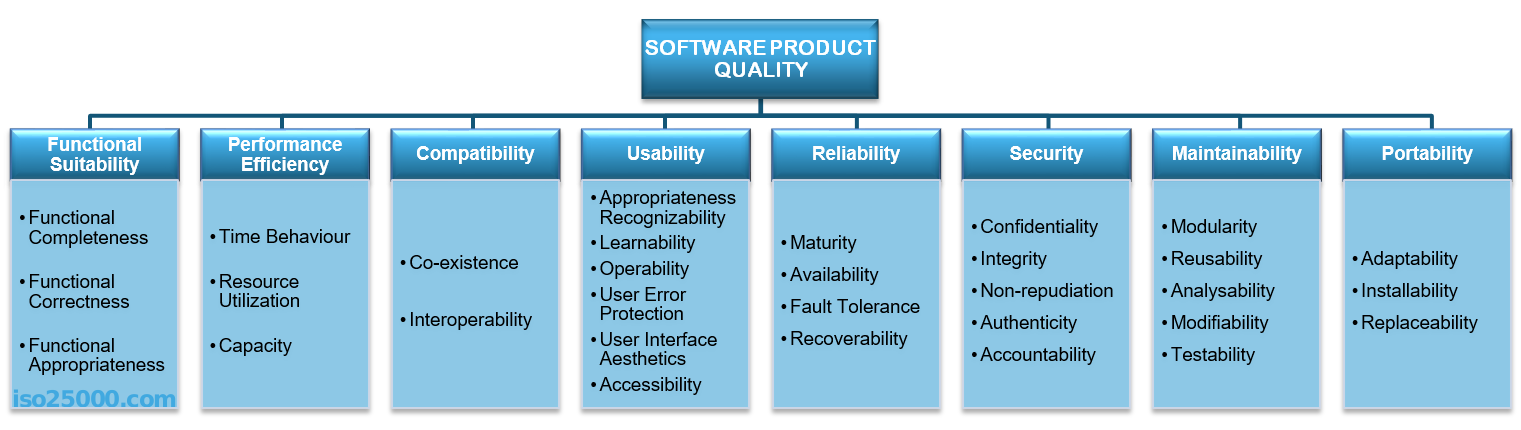
Cross-reference for Linked.Archi ISO/IEC 25010 Software Product Quality Model classes, object properties and data properties back to ToC
This section provides details for each class and property defined by Linked.Archi ISO/IEC 25010 Software Product Quality Model.Classes
- Compatibility
- Functional Suitability
- Indirect User
- Maintainability
- Performance Efficiency
- Portability
- Primary User
- Quality in Use
- Reliability
- Secondary User
- Security
- Software Product Quality
- Usability
Compatibilityc back to ToC or Class ToC
IRI: https://meta.linked.archi/iso25010#Compatibility
- has super-classes
- Software Product Quality c
- has members
- Co-Existence ni, Interoperability ni
Functional Suitabilityc back to ToC or Class ToC
IRI: https://meta.linked.archi/iso25010#FunctionalSuitability
- has super-classes
- Software Product Quality c
- has members
- Functional Appropriateness ni, Functional Completeness ni, Functional Correctness ni
Indirect Userc back to ToC or Class ToC
IRI: https://meta.linked.archi/iso25010#IndirectUser
- has super-classes
- stakeholder c
Maintainabilityc back to ToC or Class ToC
IRI: https://meta.linked.archi/iso25010#Maintainability
- has super-classes
- Software Product Quality c
- has members
- Analysability ni, Modifiability ni, Modularity ni, Reusability ni, Testability ni
Performance Efficiencyc back to ToC or Class ToC
IRI: https://meta.linked.archi/iso25010#PerformanceEfficiency
- has super-classes
- Software Product Quality c
- has members
- Capacity ni, Resource Utilization ni, Time Behaviour ni
Portabilityc back to ToC or Class ToC
IRI: https://meta.linked.archi/iso25010#Portability
- has super-classes
- Software Product Quality c
- has members
- Adaptability ni, Installability ni, Replaceability ni
Primary Userc back to ToC or Class ToC
IRI: https://meta.linked.archi/iso25010#PrimaryUser
- has super-classes
- stakeholder c
Quality in Usec back to ToC or Class ToC
IRI: https://meta.linked.archi/iso25010#QualityInUse
- has super-classes
- quality attribute c
Reliabilityc back to ToC or Class ToC
IRI: https://meta.linked.archi/iso25010#Reliability
- has super-classes
- Software Product Quality c
- has members
- Availability ni, Fault Tolerance ni, Maturity ni, Recoverability ni
Secondary Userc back to ToC or Class ToC
IRI: https://meta.linked.archi/iso25010#SecondaryUser
- has super-classes
- stakeholder c
Securityc back to ToC or Class ToC
IRI: https://meta.linked.archi/iso25010#Security
- has super-classes
- Software Product Quality c
- has members
- Accountability ni, Authenticity ni, Confidentiality ni, Integrity ni, Non-Repudiation ni
Software Product Qualityc back to ToC or Class ToC
IRI: https://meta.linked.archi/iso25010#SoftwareProductQuality
- has super-classes
- quality attribute c
- has sub-classes
- Compatibility c, Functional Suitability c, Maintainability c, Performance Efficiency c, Portability c, Reliability c, Security c, Usability c
Usabilityc back to ToC or Class ToC
IRI: https://meta.linked.archi/iso25010#Usability
- has super-classes
- Software Product Quality c
- has members
- Accessibility ni, Appropriateness Recognizability ni, Learnability ni, Operability ni, User Error Protection ni, User Interface Aesthetics ni
Annotation Properties
- abstract
- citation
- created
- creator
- definition
- description
- image
- issued
- license
- logo
- modified
- pref label
- preferred namespace prefix
- preferred namespace uri
- publisher
- source
- status
- title
- was derived from
abstractap back to ToC or Annotation Property ToC
IRI: http://purl.org/dc/terms/abstract
citationap back to ToC or Annotation Property ToC
IRI: http://schema.org/citation
createdap back to ToC or Annotation Property ToC
IRI: http://purl.org/dc/terms/created
creatorap back to ToC or Annotation Property ToC
IRI: http://purl.org/dc/terms/creator
definitionap back to ToC or Annotation Property ToC
IRI: http://www.w3.org/2004/02/skos/core#definition
descriptionap back to ToC or Annotation Property ToC
IRI: http://purl.org/dc/terms/description
imageap back to ToC or Annotation Property ToC
IRI: http://schema.org/image
issuedap back to ToC or Annotation Property ToC
IRI: http://purl.org/dc/terms/issued
licenseap back to ToC or Annotation Property ToC
IRI: http://creativecommons.org/ns#license
logoap back to ToC or Annotation Property ToC
IRI: http://schema.org/logo
modifiedap back to ToC or Annotation Property ToC
IRI: http://purl.org/dc/terms/modified
pref labelap back to ToC or Annotation Property ToC
IRI: http://www.w3.org/2004/02/skos/core#prefLabel
preferred namespace prefixap back to ToC or Annotation Property ToC
IRI: http://purl.org/vocab/vann/preferredNamespacePrefix
preferred namespace uriap back to ToC or Annotation Property ToC
IRI: http://purl.org/vocab/vann/preferredNamespaceUri
publisherap back to ToC or Annotation Property ToC
IRI: http://purl.org/dc/terms/publisher
sourceap back to ToC or Annotation Property ToC
IRI: http://purl.org/dc/terms/source
statusap back to ToC or Annotation Property ToC
IRI: http://purl.org/ontology/bibo/status
titleap back to ToC or Annotation Property ToC
IRI: http://purl.org/dc/terms/title
was derived fromap back to ToC or Annotation Property ToC
IRI: http://www.w3.org/ns/prov#wasDerivedFrom
Named Individuals
- Accessibility
- Accountability
- Adaptability
- Analysability
- Appropriateness Recognizability
- Authenticity
- Availability
- Capacity
- Co-Existence
- Confidentiality
- Fault Tolerance
- Functional Appropriateness
- Functional Completeness
- Functional Correctness
- Installability
- Integrity
- Interoperability
- Learnability
- Maturity
- Modifiability
- Modularity
- Non-Repudiation
- Operability
- Recoverability
- Replaceability
- Resource Utilization
- Reusability
- Testability
- Time Behaviour
- User Error Protection
- User Interface Aesthetics
Accessibilityni back to ToC or Named Individual ToC
IRI: https://meta.linked.archi/iso25010#Accessibility
- belongs to
- Usability c
Accountabilityni back to ToC or Named Individual ToC
IRI: https://meta.linked.archi/iso25010#Accountability
- belongs to
- Security c
Adaptabilityni back to ToC or Named Individual ToC
IRI: https://meta.linked.archi/iso25010#Adaptability
- belongs to
- Portability c
Analysabilityni back to ToC or Named Individual ToC
IRI: https://meta.linked.archi/iso25010#Analysability
- belongs to
- Maintainability c
Appropriateness Recognizabilityni back to ToC or Named Individual ToC
IRI: https://meta.linked.archi/iso25010#AppropriatenessRecognizability
- belongs to
- Usability c
Authenticityni back to ToC or Named Individual ToC
IRI: https://meta.linked.archi/iso25010#Authenticity
- belongs to
- Security c
Availabilityni back to ToC or Named Individual ToC
IRI: https://meta.linked.archi/iso25010#Availability
- belongs to
- Reliability c
Capacityni back to ToC or Named Individual ToC
IRI: https://meta.linked.archi/iso25010#Capacity
- belongs to
- Performance Efficiency c
Co-Existenceni back to ToC or Named Individual ToC
IRI: https://meta.linked.archi/iso25010#CoExistence
- belongs to
- Compatibility c
Confidentialityni back to ToC or Named Individual ToC
IRI: https://meta.linked.archi/iso25010#Confidentiality
- belongs to
- Security c
Fault Toleranceni back to ToC or Named Individual ToC
IRI: https://meta.linked.archi/iso25010#FaultTolerance
- belongs to
- Reliability c
Functional Appropriatenessni back to ToC or Named Individual ToC
IRI: https://meta.linked.archi/iso25010#FunctionalAppropriateness
- belongs to
- Functional Suitability c
Functional Completenessni back to ToC or Named Individual ToC
IRI: https://meta.linked.archi/iso25010#FunctionalCompleteness
- belongs to
- Functional Suitability c
Functional Correctnessni back to ToC or Named Individual ToC
IRI: https://meta.linked.archi/iso25010#FunctionalCorrectness
- belongs to
- Functional Suitability c
Installabilityni back to ToC or Named Individual ToC
IRI: https://meta.linked.archi/iso25010#Installability
- belongs to
- Portability c
Integrityni back to ToC or Named Individual ToC
IRI: https://meta.linked.archi/iso25010#Integrity
- belongs to
- Security c
Interoperabilityni back to ToC or Named Individual ToC
IRI: https://meta.linked.archi/iso25010#Interoperability
- belongs to
- Compatibility c
Learnabilityni back to ToC or Named Individual ToC
IRI: https://meta.linked.archi/iso25010#Learnability
- belongs to
- Usability c
Maturityni back to ToC or Named Individual ToC
IRI: https://meta.linked.archi/iso25010#Maturity
- belongs to
- Reliability c
Modifiabilityni back to ToC or Named Individual ToC
IRI: https://meta.linked.archi/iso25010#Modifiability
- belongs to
- Maintainability c
Modularityni back to ToC or Named Individual ToC
IRI: https://meta.linked.archi/iso25010#Modularity
- belongs to
- Maintainability c
Non-Repudiationni back to ToC or Named Individual ToC
IRI: https://meta.linked.archi/iso25010#NonRepudiation
- belongs to
- Security c
Operabilityni back to ToC or Named Individual ToC
IRI: https://meta.linked.archi/iso25010#Operability
- belongs to
- Usability c
Recoverabilityni back to ToC or Named Individual ToC
IRI: https://meta.linked.archi/iso25010#Recoverability
- belongs to
- Reliability c
Replaceabilityni back to ToC or Named Individual ToC
IRI: https://meta.linked.archi/iso25010#Replaceability
- belongs to
- Portability c
Resource Utilizationni back to ToC or Named Individual ToC
IRI: https://meta.linked.archi/iso25010#ResourceUtilization
- belongs to
- Performance Efficiency c
Reusabilityni back to ToC or Named Individual ToC
IRI: https://meta.linked.archi/iso25010#Reusability
- belongs to
- Maintainability c
Testabilityni back to ToC or Named Individual ToC
IRI: https://meta.linked.archi/iso25010#Testability
- belongs to
- Maintainability c
Time Behaviourni back to ToC or Named Individual ToC
IRI: https://meta.linked.archi/iso25010#TimeBehaviour
- belongs to
- Performance Efficiency c
User Error Protectionni back to ToC or Named Individual ToC
IRI: https://meta.linked.archi/iso25010#UserErrorProtection
- belongs to
- Usability c
User Interface Aestheticsni back to ToC or Named Individual ToC
IRI: https://meta.linked.archi/iso25010#UserInterfaceAesthetics
- belongs to
- Usability c
Legend back to ToC
ni: Named Individuals
Changes from last version
Acknowledgments back to ToC
The authors would like to thank Silvio Peroni for developing LODE, a Live OWL Documentation Environment, which is used for representing the Cross Referencing Section of this document and Daniel Garijo for developing Widoco, the program used to create the template used in this documentation.