Architecture Knowledge Lifecycle
Why the architecture knowledge lifecycle matters
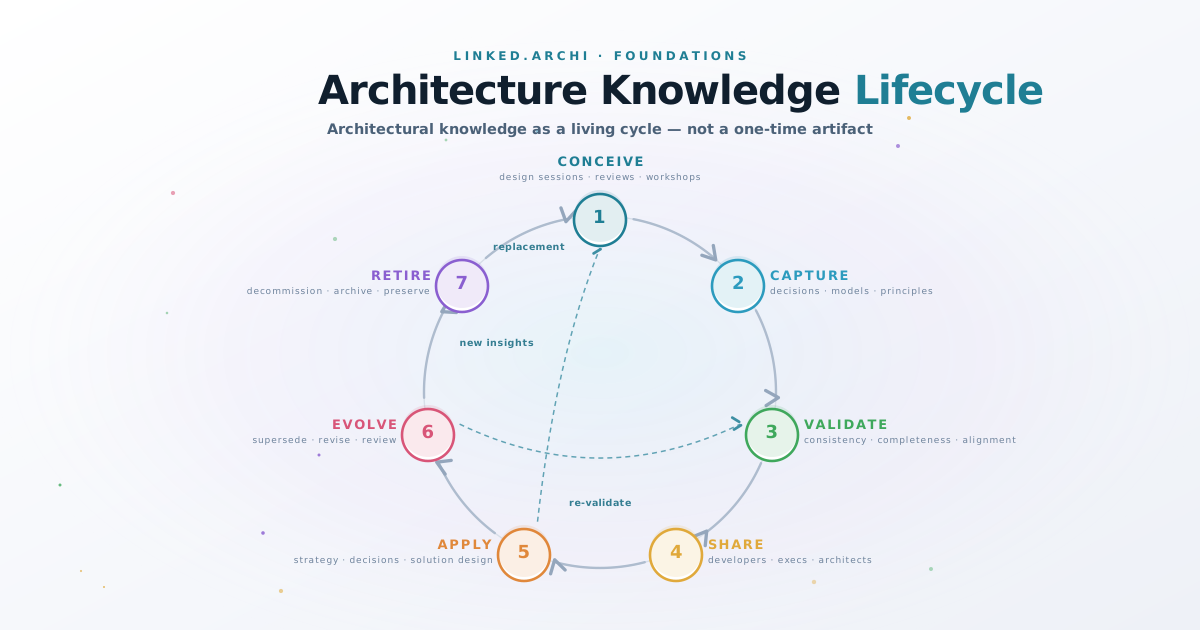
Architectural knowledge isn't static. It's conceived in design sessions, captured in models and decisions, validated against reality, shared across teams, applied in governance, evolved as context changes, and eventually retired when it no longer applies. Each stage has different requirements, different failure modes, and different tooling needs.
Most architecture practices focus on the first two stages — conceiving and capturing — drawing models, writing decisions. The later stages (validation, sharing, application, evolution, retirement) are where knowledge decays, becomes stale, or simply disappears. Understanding the full lifecycle is what separates an architecture practice that accumulates artifacts from one that maintains a living knowledge base.
This article maps the lifecycle, identifies where knowledge typically breaks down, and shows how a knowledge graph approach addresses each stage.
The lifecycle
 The seven stages of architectural knowledge — with feedback loops from application and retirement back to conception, and from evolution back to validation.
The lifecycle isn't strictly linear. Application generates new insights that feed back into conception. Evolution triggers re-validation. Retirement of one piece of knowledge often drives the need for new knowledge to replace it. But the stages are distinct enough to analyze separately.
Stage 1 — Conceive
What happens
Architectural knowledge is conceived when architects interpret data, make decisions, recognize patterns, or formulate principles. Conception happens in:
- Design sessions where architects evaluate options and select approaches
- Architecture reviews where proposals are assessed against principles and constraints
- Incident post-mortems where failure reveals previously unknown dependencies
- Strategy workshops where business direction translates into architectural implications
- Technology evaluations where new capabilities are assessed against existing patterns
The knowledge produced
 What triggers the conception of architectural knowledge and what types of knowledge are produced.
Where it breaks down
- Tacit stays tacit. The most valuable knowledge — the reasoning, the rejected alternatives, the contextual factors — often stays in the architect's head. The meeting ends, the decision is implemented, but the "why" is never externalized.
- Conception without context. Knowledge conceived in isolation from the existing knowledge base risks contradicting established principles or duplicating existing decisions.
- Timing. Knowledge is easiest to capture at the moment of conception. Every day that passes between a decision and its documentation reduces fidelity.
What helps
- Decision records written at the point of decision, not retroactively
- Templates that prompt for rationale, alternatives, and forces — not just the conclusion
- Integration with the existing knowledge graph so architects can see what already exists
Stage 2 — Capture
What happens
Capture is the act of externalizing knowledge into a persistent, retrievable form. This is where tacit becomes explicit — where the reasoning in someone's head becomes a record that others can access.
Forms of capture
| Knowledge type | Typical capture format | Knowledge graph representation |
|---|---|---|
| Decisions | ADR markdown, Confluence page | ad:Decision with forces, options, rationale |
| Principles | PDF document, wiki page | SHACL shapes + ad:Principle instances |
| Patterns | Pattern catalogue, reference architecture | ra:Pattern with tactics and quality attributes |
| Assessments | Spreadsheet, presentation | timefw:FitAssessment with evidence |
| Dependencies | Diagram, mental model | Typed relationships (am:serves, am:realizes) |
| Target state | Roadmap slide, vision document | Target architecture model with transition states |
The capture gap
 How architectural knowledge is progressively lost between emergence and structured capture.
Architectural knowledge doesn't start as a document — it starts as an event. A decision gets made in a meeting, a trade-off gets weighed on a call, a rationale gets explained in a Slack thread. The capture gap is the progressive failure to materialize that knowledge into durable, usable form:
- 100% — Emerges as tacit knowledge: decisions, rationale, trade-offs that occur in conversations, workshops, and design sessions. It exists only in participants' heads.
- ~60% — Retained informally in chat logs, whiteboard photos, meeting recordings. Accessible to those who were there, for as long as they remember where to look.
- ~25% — Captured formally in documents, models, wikis. Durable and findable, but locked in prose or proprietary formats.
- ~5% — Structured as linked, typed, machine-readable knowledge. Only this fraction is queryable, validatable, or composable with other knowledge.
The loss at each stage isn't destruction — it's failure to externalize. Knowledge that only lives in someone's head or in an ephemeral conversation isn't deleted; it's inaccessible to anyone else, at any other time. The gap is between knowledge that occurs and knowledge that gets materialized into a form others can find, use, and build on.
Where it breaks down
- Format fragmentation. Decisions in Confluence, models in Sparx EA, principles in SharePoint, assessments in Excel. Each captures something, but nothing connects them.
- Capture overhead. If recording a decision takes 45 minutes of template-filling, architects won't do it under delivery pressure.
- Missing links. A decision is captured but not linked to the elements it affects. A principle is documented but not connected to the decisions that implement it. The knowledge exists but can't be traversed.
What helps
- Lightweight capture formats (Turtle, YAML-LD) that integrate with developer workflows
- Converters that transform existing artifacts (ArchiMate XML, Backstage YAML) into the knowledge graph automatically
- Explicit linking at capture time — every decision must reference affected elements, every assessment must reference its subject
Stage 3 — Validate
What happens
Validation checks whether captured knowledge is consistent, complete, and aligned with reality. This is where errors, contradictions, and staleness are detected.
Validation dimensions
 The five dimensions of architecture knowledge validation mapped to their mechanisms.
Automated vs human validation
Some validation is automatable:
- Structural completeness — every application has an owner, every decision has a rationale (SHACL)
- Relationship validity — ArchiMate relationship rules, metamodel constraints (SHACL)
- Cross-reference integrity — decisions reference elements that exist, assessments reference valid subjects (SPARQL)
- Staleness detection — elements not updated in 12 months, decisions with expired review dates (SPARQL)
Some requires human judgment:
- Semantic accuracy — does the model actually reflect reality?
- Rationale quality — is the decision rationale sufficient for future architects to understand the choice?
- Strategic alignment — does the target state still align with business direction?
- Pattern applicability — is this pattern still appropriate given technology evolution?
Where it breaks down
- Validation never runs. Models are captured but never checked. Decisions are written but never reviewed. The knowledge base accumulates errors silently.
- Validation without consequence. Violations are detected but not acted on. The dashboard shows 200 warnings that nobody addresses.
- Point-in-time validation. Knowledge is validated once at conception but never re-validated as context changes.
What helps
- SHACL validation in CI/CD — every commit is checked, violations block merge
- Scheduled SPARQL queries that detect staleness and inconsistency
- Governance workflows that route violations to responsible parties
- Severity levels (
sh:Warningvssh:Violation) that distinguish "should fix" from "must fix"
Stage 4 — Share
What happens
Sharing makes knowledge accessible to the people who need it, in formats they can consume. This is the "last mile" problem — knowledge exists but doesn't reach its audience.
Audiences and formats
 How a single knowledge graph serves different stakeholders through generated views.
The key insight: different stakeholders need different views of the same knowledge. An executive doesn't need SPARQL. A developer doesn't need a capability heat map. But both need access to the same underlying knowledge — just rendered differently.
The sharing paradox
Architecture knowledge is most valuable when shared broadly, but most architecture practices share narrowly:
- Models stay in EA tools that only architects access
- Decisions stay in architecture wikis that developers don't read
- Principles stay in governance documents that nobody references during design
- Assessments stay in review presentations that are forgotten after the meeting
Where it breaks down
- Format lock-in. Knowledge captured in proprietary tool formats can't be shared without the tool licence.
- Push vs pull. Architecture teams push documents at stakeholders. Stakeholders need to pull knowledge at the moment of need — during design, during incidents, during planning.
- Staleness at the edge. Even when knowledge is shared, copies diverge from the source. The exported PDF becomes stale the moment the model changes.
What helps
- Generate, don't copy. Stakeholder views are generated from the graph on demand, not exported as static snapshots.
- Multiple access patterns: SPARQL for architects, MCP for AI agents, generated Markdown for developers, interactive dashboards for executives.
- Single source of truth with generated views — the graph is authoritative, everything else is a projection.
Stage 5 — Apply
What happens
Application is where knowledge influences decisions and actions. This is the stage that justifies the entire lifecycle — if knowledge isn't applied, the effort of conceiving, capturing, validating, and sharing it is wasted.
Application patterns
 How different types of architectural knowledge are applied in practice.
Active vs passive application
Passive application — knowledge is available for people to consult when they think to look for it. This depends on people knowing the knowledge exists and where to find it.
Active application — knowledge is surfaced automatically at the point of need:
- SHACL validation rejects a design that violates a principle before it's merged
- An AI agent surfaces relevant decisions when an architect starts working on a related problem
- A governance workflow triggers when a component enters a lifecycle state that requires review
- Impact analysis runs automatically when a decommission proposal is submitted
Active application is where knowledge graphs outperform document-based knowledge management. The graph can be queried programmatically, integrated into workflows, and surfaced by AI agents — without requiring humans to remember where to look.
Where it breaks down
- Knowledge exists but isn't found. The decision was recorded three years ago. Nobody on the current team knows it exists. The same decision is re-debated from scratch.
- Knowledge is found but not trusted. The principle was written in 2019. Is it still valid? Nobody knows, so it's ignored.
- Knowledge is applied inconsistently. One team follows the pattern; another team doesn't know about it. Inconsistency accumulates.
What helps
- Proactive surfacing: AI agents that retrieve relevant decisions and principles when architects work on related elements
- Automated governance: SHACL shapes that enforce principles without requiring human memory
- Provenance and currency metadata: every piece of knowledge has a last-reviewed date and responsible party
Stage 6 — Evolve
What happens
Evolution is the deliberate update of knowledge as context changes. Technology shifts, business strategy pivots, incidents reveal new information, regulations change. Knowledge that was correct yesterday may be wrong today.
Evolution triggers
 What triggers the evolution of architectural knowledge and the resulting actions.
Evolution vs decay
There's a critical difference between deliberate evolution and passive decay:
- Evolution is intentional: "We reviewed Decision-042 and it no longer applies because the constraint it addressed has been removed. Superseded by Decision-089."
- Decay is neglect: Decision-042 silently becomes irrelevant. Nobody marks it as superseded. New architects find it and don't know whether to follow it.
A healthy knowledge lifecycle has explicit evolution. An unhealthy one has silent decay.
The versioning problem
When knowledge evolves, what happens to the old version?
- Decisions should be superseded, not deleted. The old decision and its rationale remain as history — future architects may need to understand why something was done differently before.
- Models should maintain temporal state. The current-state model and target-state model are both valid — they represent different points in time.
- Principles should be versioned with effective dates. A principle that changes should show its history.
- Assessments should be timestamped. A TIME classification from 2023 may no longer be valid in 2026.
Use this supersession pattern to retire a decision without losing its history — the old decision stays queryable and links to the one that replaces it:
ex:decision-042 a ad:Decision ;
    ad:status ad:Superseded ;
    ad:supersededBy ex:decision-089 ;
    ad:supersededDate "2026-03-15"^^xsd:date ;
    ad:rationale "Event-driven selected for payment domain..." .

ex:decision-089 a ad:Decision ;
    ad:status ad:Accepted ;
    ad:supersedes ex:decision-042 ;
    ad:rationale "Synchronous gRPC now preferred for payment domain
                  because latency requirements tightened to <10ms P99
                  and the event-driven approach couldn't guarantee ordering..." .
Where it breaks down
- No review cadence. Knowledge is conceived but never revisited. Decisions from 2019 remain "Accepted" even though the world has changed.
- Evolution without trace. The model is updated but the reason for the change isn't recorded. Future architects see the current state but not the journey.
- Partial evolution. A decision is superseded but the SHACL shapes that enforced it aren't updated. The principle document changes but the validation rules don't.
What helps
- Scheduled review dates on decisions and assessments (
ad:reviewDate) - SPARQL queries that surface knowledge past its review date
- Supersession chains that preserve history while clearly marking current state
- CI/CD that detects inconsistencies between decisions and their implementing SHACL shapes
Stage 7 — Retire
What happens
Retirement is the deliberate removal of knowledge from active use. Not deletion — retirement. The knowledge remains accessible for historical reference but is clearly marked as no longer applicable.
What gets retired
- Decisions about systems that no longer exist
- Principles that have been fully superseded
- Patterns that are no longer recommended
- Assessments of decommissioned applications
- Target states that have been achieved (or abandoned)
Retirement vs deletion
 Why architectural knowledge should be retired rather than deleted — preserving history while excluding from active governance.
Retired knowledge has value:
- Institutional memory — why was the previous system designed that way? What went wrong?
- Pattern mining — which decisions led to good outcomes? Which led to problems?
- Onboarding — new architects can trace the evolution of the architecture
- Audit — regulatory requirements may demand historical records
Where it breaks down
- Nothing is ever retired. The knowledge base grows indefinitely. Active and historical knowledge are mixed. Architects can't distinguish current guidance from obsolete records.
- Retirement without marking. Old decisions are "archived" by moving them to a folder nobody checks, without updating their status in the graph.
- Cascading retirement. When a system is decommissioned, all related decisions, assessments, and relationships should be retired. In practice, orphaned knowledge accumulates.
What helps
- Explicit retirement status (
ad:status ad:Retired,arch:lifecycleState arch:Decommissioned) - SPARQL queries that exclude retired knowledge from active governance
- Cascading retirement workflows: when an element is retired, surface all related knowledge for review
- Separate active and historical views — the default view shows only active knowledge
The full picture
The full lifecycle with feedback loops — application generates new insights, evolution triggers re-validation, retirement drives the need for replacement.
Lifecycle health indicators
How do you know if your architecture knowledge lifecycle is healthy? These indicators map to each stage:
| Stage | Healthy | Unhealthy |
|---|---|---|
| Conceive | Decisions recorded at point of decision; rationale includes alternatives | Decisions reconstructed months later; rationale is "we decided X" |
| Capture | Structured, linked, queryable; integrated with development workflow | Scattered across tools; unlinked documents; manual effort to record |
| Validate | Automated in CI/CD; violations addressed within days | Never validated; or validated but violations ignored |
| Share | Generated views for each audience; knowledge found at point of need | Locked in EA tools; shared only via presentations |
| Apply | Principles enforced automatically; AI surfaces relevant knowledge | Principles exist but aren't checked; knowledge rediscovered by accident |
| Evolve | Scheduled reviews; explicit supersession; versioned history | No review cadence; silent staleness; "is this still valid?" |
| Retire | Explicit retirement; history preserved; cascading cleanup | Nothing retired; active and obsolete mixed; orphaned knowledge |
The decay curve
Without active lifecycle management, architectural knowledge decays predictably:
 How architectural knowledge accuracy degrades over time without active lifecycle management.
The decay isn't uniform. Different knowledge types decay at different rates:
- Runtime dependencies decay fastest — infrastructure changes weekly
- Application inventory decays monthly — new services, decommissions
- Capability maps decay quarterly — organizational restructuring
- Architecture principles decay slowly — fundamental guidance is durable
- Decision rationale doesn't decay — the reasoning was valid at the time, even if the decision is later superseded
This means validation cadence should match decay rate. Runtime dependencies need continuous reconciliation. Principles need annual review. Decision rationale needs no re-validation — only supersession when context changes.
How Linked.Archi supports each stage
| Stage | Mechanism | How it works |
|---|---|---|
| Conceive | Templates, ontology structure | Decision templates prompt for forces, options, rationale. The ontology structure makes it clear what needs to be recorded. |
| Capture | OWL ontologies, Turtle syntax, converters | Knowledge is captured as RDF — typed, linked, queryable from the start. Converters transform existing artifacts automatically. |
| Validate | SHACL shapes, CI/CD integration | Validation runs on every commit. Completeness, consistency, and conformance are checked automatically. |
| Share | Generators, MCP server, SPARQL | Multiple output formats from a single source. Each audience gets their preferred view. AI agents access the graph directly. |
| Apply | SPARQL queries, SHACL governance, AI agents | Principles are enforced as SHACL constraints. AI agents surface relevant knowledge at point of need. Impact queries answer "what if?" |
| Evolve | Supersession predicates, versioned IRIs, review dates | ad:supersededBy chains preserve history. ad:reviewDate triggers re-evaluation. Versioned ontology IRIs track schema evolution. |
| Retire | Lifecycle states, archive queries | arch:lifecycleState marks retired elements. Default queries exclude retired knowledge. History remains accessible. |
Relationship to the data/knowledge distinction
This lifecycle applies specifically to architectural knowledge — not architectural data. The distinction between data and knowledge matters here because:
- Data has a simpler lifecycle: collect → store → update → delete. It's factual and verifiable against running systems.
- Knowledge has the richer lifecycle described here because it involves interpretation, rationale, and judgment that can't be automatically harvested or verified.
The lifecycle stages where knowledge differs most from data:
- Conceive — data can be discovered automatically (APM, cloud APIs); knowledge requires human interpretation
- Validate — data can be verified against reality; knowledge requires judgment about relevance and accuracy
- Evolve — data is updated (the new value replaces the old); knowledge is superseded (the old reasoning is preserved alongside the new)
- Retire — data can be deleted when the entity no longer exists; knowledge should be preserved as institutional memory
References
Architecture knowledge management
- Kruchten, P., Lago, P., & van Vliet, H. (2006). "Building Up and Reasoning About Architectural Knowledge." QoSA 2006, LNCS 4214.
- Jansen, A. & Bosch, J. (2005). "Software Architecture as a Set of Architectural Design Decisions." WICSA 2005.
- Capilla, R., Jansen, A., Tang, A., Avgeriou, P., & Babar, M.A. (2016). "10 Years of Software Architecture Knowledge Management." JSS, 116, 191–205.
- Farenhorst, R. & van Vliet, H. (2008). "Understanding How to Support Architects in Sharing Knowledge." SHARK 2008.
- Lago, P. & Avgeriou, P. (2006). "First Workshop on Sharing and Reusing Architectural Knowledge." ACM SIGSOFT Software Engineering Notes, 31(5).
Knowledge lifecycle models
- Nonaka, I. & Takeuchi, H. (1995). The Knowledge-Creating Company. Oxford University Press.
- Wiig, K.M. (1993). Knowledge Management Foundations. Schema Press.
- Davenport, T.H. & Prusak, L. (1998). Working Knowledge. Harvard Business School Press.
Linked.Archi documentation
- Architectural Data vs Architectural Knowledge — The foundational distinction
- Enterprise Ontologies and the AI Context Problem — Why formalization is urgent
- How Linked.Archi Bridges the Gap — The sharing and application stages in detail
- Architecture & Approach — Technical architecture of the ecosystem