ArchiMate 4.0 Primer & Modelling Guide — Enterprise Architecture with Linked.Archi
Tailor · Model · Validate · Derive · Present · Link
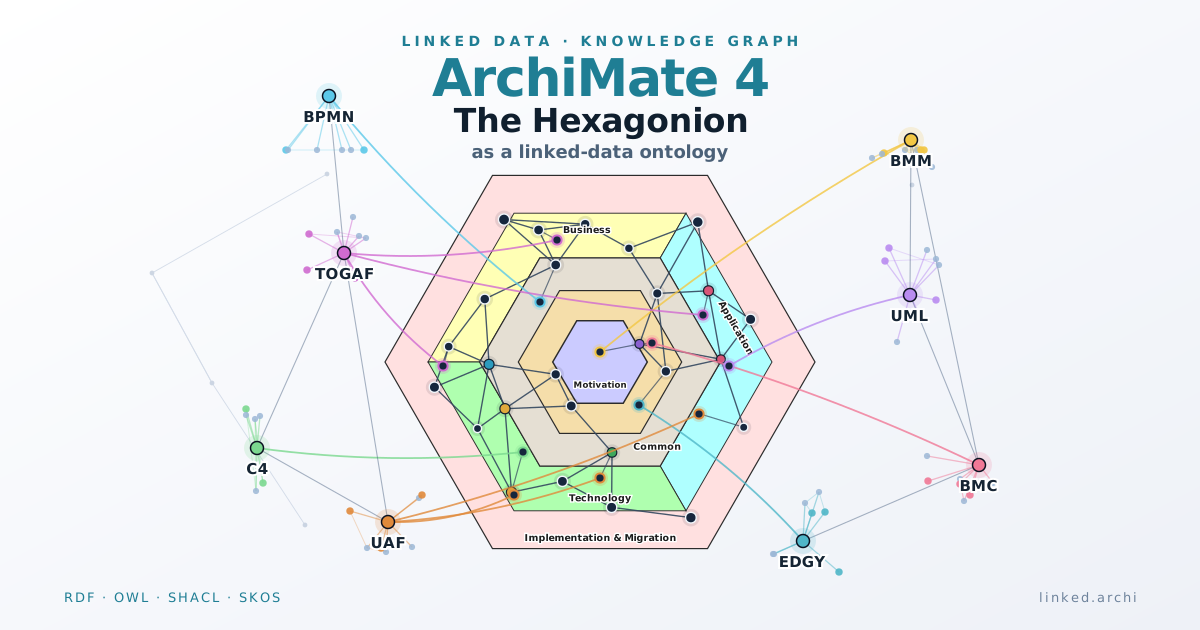
Moving to ArchiMate 4.0 means rethinking layer-based models as domain-based ones, and diagram-only tools give you no way to query that structure, validate it against governance rules, or trace impact across domains. Linked.Archi treats ArchiMate 4.0 as a queryable knowledge graph, so the merged Common-Domain elements and the new domain organization become something you can validate, derive facts from, and query directly.
This guide introduces ArchiMate 4.0 (the "Hexagonion") as formalized in Linked.Archi, and walks through everything the language and its semantic assets let you do: read a model, author one, validate it, derive new facts from it, present it to different audiences, tailor it to your organization, and link it to other notations.
It is both breadth-complete and self-contained: every capability is demonstrated here with enough depth to be actionable, including the full reference patterns, the derivation mechanics, and the validation pipeline.
Orientation
What ArchiMate 4.0 is
ArchiMate is an open and independent enterprise architecture modelling language published by The Open Group. Version 4.0 — nicknamed the "Hexagonion" — introduces a fundamental restructuring from the layer-based model of 3.x to a domain-based organization.
Key changes from 3.x:
- Layers → Domains — Business, Application, Technology layers replaced by Common, Business, Application, Technology, Strategy, Motivation, and Implementation & Migration domains
- Merged behaviour elements — per-layer duplicates (BusinessProcess, ApplicationProcess, TechnologyProcess) merged into single cross-domain elements (Process, Function, Event, Service)
- Common Domain — new domain for generic, domain-independent concepts (Role, Collaboration, Path, Grouping, Location)
- Merged Technology & Physical — the Physical layer from 3.x is merged into the Technology Domain (Equipment, Facility, Distribution Network, Material)
- Removed elements — Interaction, Contract, Representation, Gap, ImplementationEvent, Constraint removed
ArchiMate 4.0 specification: https://pubs.opengroup.org/architecture/archimate4-doc/
What Linked.Archi adds
In Linked.Archi, ArchiMate 4.0 is not a diagramming convention — it is a formally defined modelling language whose definition is a queryable knowledge graph. The language is published as a set of W3C-standard semantic assets, tied together by a single manifest. Each W3C standard plays one role, with no overlap:
- OWL defines what the concepts mean — the element and relationship vocabulary and its hierarchy.
- SHACL defines what a conforming model must satisfy — closed-world validation rules.
- SKOS defines how concepts are classified and navigated — the taxonomies behind palettes, filters, and views.
- SPARQL is how you query and traverse the model.
This is what turns "boxes and arrows" into something a machine can validate, reason over, and generate documents from.
The manifest is your map
A Linked.Archi metamodel (arch:Metamodel) is a manifest — a single resource that aggregates all the assets making up the language. The ArchiMate 4.0 manifest lives at https://meta.linked.archi/archimate4/metamodel# and ties together the resources below. Keep this picture in mind; every section of this guide "lights up" one node of it.
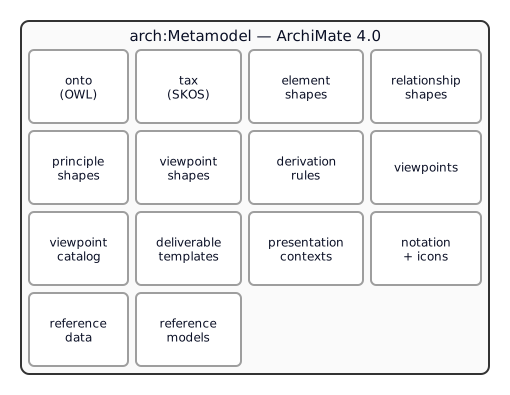 The manifest aggregates all semantic assets making up the language definition.
Browse the live manifest ▶
The manifest aggregates all semantic assets making up the language definition.
Browse the live manifest ▶
am4mm:ArchiMate4
    a                              arch:Metamodel ;
    arch:modelConcepts             <https://meta.linked.archi/archimate4/onto#> ;
    arch:conceptClassification     <https://meta.linked.archi/archimate4/tax#> ;
    arch:formalRules               <https://meta.linked.archi/archimate4/shapes#> ,
                                   <https://meta.linked.archi/archimate4/element-shapes#> ,
                                   <https://meta.linked.archi/archimate4/principle-shapes#> ;
    arch:derivationRules           <https://meta.linked.archi/archimate4/derivation#> ;
    arch:architectureViewpoints    <https://meta.linked.archi/archimate4/viewpoints#> ;
    arch:viewpointLibrary          am4vp:ViewpointCatalog ;
    arch:hasDeliverableTemplate    am4dt:ArchitectureDefinitionDocument ,
                                   am4dt:ArchitectureRequirementsSpec ,
                                   am4dt:ArchitecturePrinciplesDocument ;
    arch:referenceData             am4rd:ArchiMateReferenceData ;
    arch:referenceModels           am4rm:ArchiMateReferenceModels ;
    arch:presentationContextScheme am4pc:ArchiMatePresentationContexts ;
    arch:notationSet               am4not:ArchiMate40StandardNotation .
File structure
| File | Purpose |
|---|---|
archimate4-metamodel.ttl |
Metamodel manifest aggregating all constituent resources |
archimate4-onto.ttl |
Element classes, abstract hierarchy, and 11 relationship types (three-declaration pattern) |
archimate4-tax.ttl |
SKOS taxonomy classifying elements by domain and aspect |
archimate4-element-shapes.ttl |
SHACL shapes for structural integrity |
archimate4-relationship-shapes.ttl |
SHACL shapes for valid source/target pairs (relationship validity matrix) |
archimate4-principle-shapes.ttl |
SHACL shapes for architecture governance principles |
archimate4-viewpoint-shapes.ttl |
SHACL shapes validating viewpoint conformance |
archimate4-viewpoints.ttl |
Viewpoint definitions with allowed concepts and stakeholder targeting |
archimate4-derivation-rules.ttl |
SPARQL-based derivation rules with PROV-O provenance |
archimate4-deliverable-templates.ttl |
Document templates (ADD, ARS, APD) |
archimate4-reference-data.ttl |
Reference data (access types, etc.) |
archimate4-reference-models.ttl |
Architecture patterns |
archimate4-presentation-contexts.ttl |
Stakeholder-specific rendering themes |
archimate4-notation.ttl |
Visual notation set |
icons/ |
SVG icons for all element types |
Prerequisites
To author and validate a model, load the assets in this order (foundation first):
core/core-onto.ttl                                       # shared foundation (arch:*)
modelingLanguages/archimate/4.0/archimate4-onto.ttl      # elements + relationships
modelingLanguages/archimate/4.0/archimate4-tax.ttl       # SKOS taxonomy
modelingLanguages/archimate/4.0/archimate4-element-shapes.ttl
modelingLanguages/archimate/4.0/archimate4-relationship-shapes.ttl
modelingLanguages/archimate/4.0/archimate4-viewpoints.ttl
modelingLanguages/archimate/4.0/archimate4-notation.ttl
modelingLanguages/archimate/4.0/archimate4-metamodel.ttl # the manifest (entry point)
Throughout, these prefixes are assumed:
@prefix owl:     <http://www.w3.org/2002/07/owl#> .
@prefix rdf:     <http://www.w3.org/1999/02/22-rdf-syntax-ns#> .
@prefix rdfs:    <http://www.w3.org/2000/01/rdf-schema#> .
@prefix xsd:     <http://www.w3.org/2001/XMLSchema#> .
@prefix skos:    <http://www.w3.org/2004/02/skos/core#> .
@prefix sh:      <http://www.w3.org/ns/shacl#> .
@prefix prov:    <http://www.w3.org/ns/prov#> .
@prefix dcterms: <http://purl.org/dc/terms/> .
@prefix arch:    <https://meta.linked.archi/core#> .
@prefix am4:     <https://meta.linked.archi/archimate4/onto#> .
@prefix am4vp:   <https://meta.linked.archi/archimate4/viewpoints#> .
@prefix am4rd:   <https://meta.linked.archi/archimate4/reference-data#> .
Part 1 — The Language
ArchiMate 4.0 classifies every element along two orthogonal dimensions: by aspect (what kind of thing it is) and by domain (where it belongs). In Linked.Archi both dimensions are real, queryable structures, not just prose — they are the tax SKOS concept scheme.
By Aspect (what kind of thing)
 The aspect hierarchy — see the full ArchiMate 4 Taxonomy for all elements under each aspect.
 The six aspect dimensions of ArchiMate 4.
- Behaviour — dynamic aspects (what happens)
- Internal Behaviour
- Service
- Event
- Strategy Behaviour
- Work Package
- Structure — entities that exist
- Resource
- Active Structure
- Internal Active Structure
- External Active Structure
- Path, Communication Network, Distribution Network
- Passive Structure
- Motivation — context and reasons behind the architecture
- Composite — elements combining multiple aspects or domains
By Domain (where it belongs)
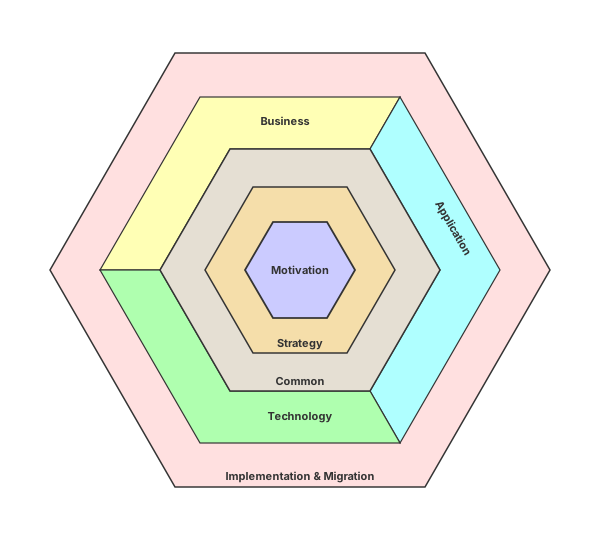 Seven architecture domains replace the traditional layer model — see the full ArchiMate 4 Taxonomy for all elements under each domain.
| Domain | Scope | Key elements |
|---|---|---|
| Common | Domain-independent | Process, Function, Event, Service, Role, Collaboration, Path, Grouping, Location |
| Business | Business-specific | Business Actor, Business Interface, Business Object, Product |
| Application | Software systems | Application Component, Application Interface, Data Object |
| Technology | Infrastructure & physical | Node, Device, System Software, Technology Interface, Communication Network, Distribution Network, Equipment, Facility, Artifact, Material |
| Strategy | Strategic planning | Resource, Capability, Value Stream, Course of Action |
| Motivation | Why architecture exists | Stakeholder, Driver, Assessment, Goal, Outcome, Principle, Requirement, Meaning, Value |
| Implementation & Migration | Change management | Work Package, Deliverable, Plateau |
The bridge — these dimensions are an asset. Both dimensions are published as one SKOS concept scheme (tax). Each element is classified twice — once under a domain, once under an aspect — so a single SPARQL query can ask "every Behaviour element" or "every Common-Domain element" without enumerating types by hand:
am4:ArchiMateConceptScheme a skos:ConceptScheme ;
    skos:prefLabel "ArchiMate 4.0 Concept Scheme"@en ;
    skos:hasTopConcept am4:CommonDomain , am4:BusinessDomain , am4:ApplicationDomain ,
                       am4:TechnologyDomain , am4:StrategyDomain , am4:MotivationDomain ,
                       am4:ImplementationMigrationDomain ,
                       am4:BehaviourAspect , am4:ActiveStructureAspect , am4:PassiveStructureAspect ,
                       am4:MotivationAspect , am4:CompositeAspect , am4:StrategyAspect .

# "Process" is classified on BOTH axes:
am4:ProcessConcept a skos:Concept ;
    skos:prefLabel "Process"@en ;
    skos:broader am4:CommonDomain , am4:BehaviourAspect ;
    rdfs:seeAlso am4:Process .          # links the SKOS concept to the OWL class (no punning)
Note the rdfs:seeAlso bridge: the SKOS concept and the OWL class are kept as separate resources (Linked.Archi never puns an IRI as both). The class carries logical semantics for reasoners and shapes; the concept carries navigation for palettes and filters.
Elements by Domain — Visual Notation
Below, each domain's concrete elements are shown with their notation. Under each table is one representative OWL declaration so you can see the shape of an element class.
Common Domain
| Element | Notation | Aspect | IRI |
|---|---|---|---|
| Process |  |
Internal Behaviour | am4:Process |
| Function |  |
Internal Behaviour | am4:Function |
| Event | 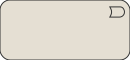 |
Event | am4:Event |
| Service | 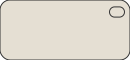 |
External Behaviour | am4:Service |
| Role |  |
Internal Active Structure | am4:Role |
| Collaboration |  |
Internal Active Structure | am4:Collaboration |
| Path |  |
Active Structure | am4:Path |
| Grouping | 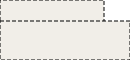 |
Composite | am4:Grouping |
| Location |  |
Composite | am4:Location |
am4:Process a owl:Class ;
    rdfs:subClassOf am4:CommonDomainElement , am4:BehaviourElement ;
    arch:isAbstractClass false ;
    skos:prefLabel "Process"@en ;
    skos:definition "A sequence of behaviours that achieves a specific outcome."@en .
The 4.0 headline.
am4:Process,am4:Function,am4:Event, andam4:Serviceare single Common-Domain classes — the merge of the per-layer duplicates from 3.x. A process in the business and a process in the application use the same class, distinguished (if you wish) by what they are assigned to and what they serve, not by their type.
Business Domain
| Element | Notation | Aspect | IRI |
|---|---|---|---|
| Business Actor |  |
Internal Active Structure | am4:BusinessActor |
| Business Interface |  |
External Active Structure | am4:BusinessInterface |
| Business Object | 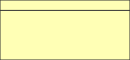 |
Passive Structure | am4:BusinessObject |
| Product |  |
Composite | am4:Product |
am4:BusinessObject a owl:Class ;
    rdfs:subClassOf am4:BusinessDomainElement , am4:PassiveStructureElement ;
    arch:isAbstractClass false ;
    skos:prefLabel "Business Object"@en .
Application Domain
| Element | Notation | Aspect | IRI |
|---|---|---|---|
| Application Component |  |
Internal Active Structure | am4:ApplicationComponent |
| Application Interface |  |
External Active Structure | am4:ApplicationInterface |
| Data Object | 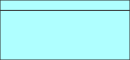 |
Passive Structure | am4:DataObject |
am4:ApplicationComponent a owl:Class ;
    rdfs:subClassOf am4:ApplicationDomainElement , am4:InternalActiveStructureElement ;
    arch:isAbstractClass false ;
    skos:prefLabel "Application Component"@en .
Technology Domain
| Element | Notation | Aspect | IRI |
|---|---|---|---|
| Node |  |
Internal Active Structure | am4:Node |
| Device | 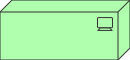 |
Internal Active Structure | am4:Device |
| System Software |  |
Internal Active Structure | am4:SystemSoftware |
| Technology Interface |  |
External Active Structure | am4:TechnologyInterface |
| Communication Network |  |
Active Structure | am4:CommunicationNetwork |
| Distribution Network |  |
Active Structure | am4:DistributionNetwork |
| Equipment | 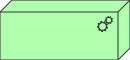 |
Internal Active Structure | am4:Equipment |
| Facility | 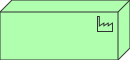 |
Internal Active Structure | am4:Facility |
| Artifact |  |
Passive Structure | am4:Artifact |
| Material |  |
Passive Structure | am4:Material |
am4:Node a owl:Class ;
    rdfs:subClassOf am4:TechnologyDomainElement , am4:InternalActiveStructureElement ;
    arch:isAbstractClass false ;
    skos:prefLabel "Node"@en .
Strategy Domain
| Element | Notation | Aspect | IRI |
|---|---|---|---|
| Capability | 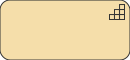 |
Strategy Behaviour | am4:Capability |
| Resource |  |
Structure | am4:Resource |
| Value Stream |  |
Strategy Behaviour | am4:ValueStream |
| Course of Action | 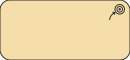 |
Strategy Behaviour | am4:CourseOfAction |
am4:Capability a owl:Class ;
    rdfs:subClassOf am4:StrategyDomainElement , am4:StrategyElement ;
    arch:isAbstractClass false ;
    skos:prefLabel "Capability"@en .
Motivation Domain
| Element | Notation | Aspect | IRI |
|---|---|---|---|
| Stakeholder |  |
Motivation | am4:Stakeholder |
| Driver |  |
Motivation | am4:Driver |
| Assessment | 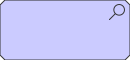 |
Motivation | am4:Assessment |
| Goal | 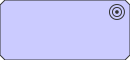 |
Motivation | am4:Goal |
| Outcome | 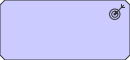 |
Motivation | am4:Outcome |
| Principle |  |
Motivation | am4:Principle |
| Requirement |  |
Motivation | am4:Requirement |
| Meaning |  |
Motivation | am4:Meaning |
| Value | 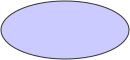 |
Motivation | am4:Value |
am4:Requirement a owl:Class ;
    rdfs:subClassOf am4:MotivationDomainElement , am4:MotivationElement ;
    arch:isAbstractClass false ;
    skos:prefLabel "Requirement"@en .
Implementation & Migration Domain
| Element | Notation | Aspect | IRI |
|---|---|---|---|
| Work Package | 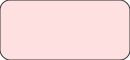 |
Behaviour | am4:WorkPackage |
| Deliverable | 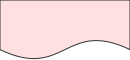 |
Passive Structure | am4:Deliverable |
| Plateau |  |
Composite | am4:Plateau |
am4:WorkPackage a owl:Class ;
    rdfs:subClassOf am4:ImplementationMigrationDomainElement , am4:BehaviourElement ;
    arch:isAbstractClass false ;
    skos:prefLabel "Work Package"@en .
Abstract vs Concrete Classes
The two hierarchies above are anchored by abstract classes — marked arch:isAbstractClass true. They are not instantiable (you never type an element as am4:BehaviourElement); they exist so that queries, shapes, and tool palettes can generalize. Because rdfs:subClassOf carries monotonic inference, anything typed as am4:Process is automatically an am4:BehaviourElement, an am4:CommonDomainElement, and an arch:Element — without you asserting it.
| Abstract (by aspect) | Abstract (by domain) | Concrete examples |
|---|---|---|
BehaviourElement |
CommonDomainElement |
Process, Function, Event, Service |
ActiveStructureElement |
BusinessDomainElement |
Business Actor, Business Interface |
InternalActiveStructureElement |
ApplicationDomainElement |
Application Component |
ExternalActiveStructureElement |
TechnologyDomainElement |
Node, Device, System Software |
PassiveStructureElement |
StrategyDomainElement |
Resource, Capability, Value Stream |
MotivationElement |
ImplementationMigrationDomainElement |
Work Package, Plateau |
CompositeElement |
Grouping, Location |
Relationships (11 types)
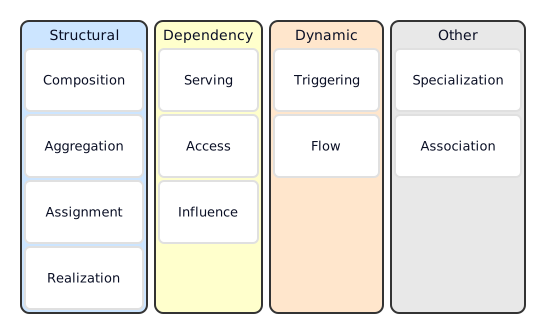 Eleven relationship types organized by category.
| Category | Relationship | Meaning | IRI |
|---|---|---|---|
| Structural | Composition | Element consists of other elements (existence dependency) | am4:composedOf |
| Structural | Aggregation | Element combines other elements | am4:aggregates |
| Structural | Assignment | Active structure performs behaviour | am4:assignedTo |
| Structural | Realization | Element plays a critical role in creation or operation of another | am4:realizes |
| Dependency | Serving | Element provides its functionality to another | am4:serves |
| Dependency | Access | Behaviour or active structure observes or acts upon passive structure | am4:accesses |
| Dependency | Influence | Element affects the implementation or achievement of a motivation element | am4:influences |
| Dynamic | Triggering | Temporal or causal relationship between elements | am4:triggers |
| Dynamic | Flow | Transfer from one element to another | am4:flowsTo |
| Other | Specialization | Element is a particular kind of another element | am4:specializes |
| Other | Association | Unspecified relationship, or one not represented by another type | am4:associatedWith |
The Three-Declaration Relationship Pattern
This is the single most distinctive Linked.Archi pattern. Every relationship type has three representations, because enterprise architecture needs both cheap graph traversal and rich relationship management. Using Serving as the example:
## 1. Direct predicate — for fast SPARQL traversal and analytics
am4:serves a owl:ObjectProperty ;
    skos:prefLabel "Serves"@en ;
    arch:domainIncludes arch:Element ;          # tooling hint, not a constraint
    arch:rangeIncludes  arch:Element .

## 2. Qualified relationship class — a reified resource carrying metadata, lifecycle, provenance
am4:Serving a owl:Class ;
    rdfs:subClassOf arch:QualifiedRelationship ;
    arch:unqualifiedForm am4:serves ;
    skos:prefLabel "Serving"@en .

## 3. Qualified property — navigates from a source to its qualified resource
am4:qualifiedServes a owl:ObjectProperty ;
    rdfs:range am4:Serving ;
    arch:unqualifiedForm am4:serves .
Why three? The direct predicate (am4:serves) answers "what serves what?" in one cheap triple pattern. But suppose the same component serves the same process in two different ways, each with its own lifecycle state and owner — a bare predicate cannot tell those edges apart. The qualified am4:Serving resource can, because it is a thing in its own right with arch:source, arch:target, and any metadata you attach. The RDF 1.2 reification bridge ties the two together:
# The cheap edge — always present
ex:BookingService am4:serves ex:FreightOperations .

# The same fact as a managed resource, with metadata
ex:serving-001 a am4:Serving ;
    arch:source  ex:BookingService ;
    arch:target  ex:FreightOperations ;
    arch:lifecycleState "production" ;
    dcterms:created "2025-06-27"^^xsd:date ;
    rdf:reifies <<( ex:BookingService am4:serves ex:FreightOperations )>> .   # RDF 1.2 bridge
Rule of thumb: write the direct predicate by default. Promote an edge to a qualified resource only when you need to say something about the relationship itself (provenance, lifecycle, multiple distinct edges, confidence). The full rationale is in the Relationship Modelling Guide.
Part 2 — Authoring a Model
Everything from here on uses one running example, NordFreight Logistics — a Scandinavian freight company modernising its shipment-tracking platform and integrating with EU customs systems for post-Brexit trade compliance. The complete, validatable model is at examples/nordfreight/nordfreight-model.ttl.
Model Header
A model is an arch:Model that declares which metamodel it conforms to:
@prefix : <https://model.nordfreight.example/> .

:NordFreightModel
    a                             arch:Model ;
    skos:prefLabel                "NordFreight Logistics — Architecture Model"@en ;
    arch:modelConformsToMetamodel <https://meta.linked.archi/archimate4/metamodel#ArchiMate4> ;
    dcterms:created               "2025-06-27"^^xsd:date .
Element Patterns
Each element needs only rdf:type and a language-tagged skos:prefLabel to be valid. Grouped by domain:
## Motivation
:EUCustomsCompliance a am4:Requirement ; skos:prefLabel "EU Customs Compliance"@en .
:OperationalEfficiency a am4:Goal ; skos:prefLabel "Operational Efficiency"@en .
:ShipperStakeholder a am4:Stakeholder ; skos:prefLabel "Shipper"@en .

## Strategy
:ShipmentTracking a am4:Capability ; skos:prefLabel "Shipment Tracking"@en .
:FreightBooking a am4:Capability ; skos:prefLabel "Freight Booking"@en .
:CustomsClearance a am4:Capability ; skos:prefLabel "Customs Clearance"@en .

## Business + Common-Domain behaviour
:BookingProcess a am4:Process ; skos:prefLabel "Booking Process"@en .
:TrackingService a am4:Service ; skos:prefLabel "Shipment Tracking Service"@en .
:FreightOperations a am4:Role ; skos:prefLabel "Freight Operations"@en .
:Shipment a am4:BusinessObject ; skos:prefLabel "Shipment"@en .

## Application — Functions (behaviour performed by components)
:BookingFunction a am4:Function ; skos:prefLabel "Booking Function"@en .
:TrackingFunction a am4:Function ; skos:prefLabel "Tracking Function"@en .
:CustomsFunction a am4:Function ; skos:prefLabel "Customs Processing"@en .

## Application — Services (exposed to consumers)
:BookingService a am4:Service ; skos:prefLabel "Booking Service"@en .

## Application — Components (active structure)
:TMS a am4:ApplicationComponent ; skos:prefLabel "Transport Management System"@en .
:TrackingPortal a am4:ApplicationComponent ; skos:prefLabel "Tracking Portal"@en .
:CustomsGateway a am4:ApplicationComponent ; skos:prefLabel "Customs Gateway"@en .
:ShipmentData a am4:DataObject ; skos:prefLabel "Shipment Data"@en .

## Technology
:AzureCloud a am4:Node ; skos:prefLabel "Azure North Europe"@en .
:K8sCluster a am4:SystemSoftware ; skos:prefLabel "AKS Kubernetes Cluster"@en .
:IoTGateway a am4:Device ; skos:prefLabel "IoT Tracking Gateway"@en .

## Implementation & Migration
:PlatformModernisation a am4:WorkPackage ; skos:prefLabel "Platform Modernisation"@en .
:TargetState a am4:Plateau ; skos:prefLabel "Target Architecture 2027"@en .
Relationship Patterns
Direct predicates for the bulk of the model:
## Assignment — active structure performs behaviour
:FreightOperations am4:assignedTo :BookingProcess .

## Application layer — the proper Component → Function → Service → Consumer pattern
:TMS           am4:assignedTo :BookingFunction .     # component performs function
:BookingFunction am4:realizes :BookingService .      # function provides service
:BookingService  am4:serves   :FreightOperations .   # service serves the role

:TrackingPortal  am4:assignedTo :TrackingFunction .
:TrackingFunction am4:realizes :TrackingService .
:TrackingService  am4:serves   :FreightOperations .

:CustomsGateway  am4:assignedTo :CustomsFunction .   # component performs function
:CustomsFunction am4:realizes :CustomsClearance .    # function realizes capability directly

## Realization — process/service realizes a capability
:BookingProcess am4:realizes :FreightBooking .
:TrackingService am4:realizes :ShipmentTracking .

## Serving — technology layer (valid: infra serves component)
:K8sCluster am4:serves :TMS .          # system software serves the application
:AzureCloud am4:serves :K8sCluster .   # node serves the system software

## Access — behaviour accesses passive structure
:BookingProcess am4:accesses :Shipment .
:TMS am4:accesses :ShipmentData .

## Structural + dynamic
:AzureCloud am4:composedOf :K8sCluster .
:TMS am4:flowsTo :CustomsGateway .
:BookingProcess am4:triggers :TrackingService .
:CustomsGateway am4:realizes :EUCustomsCompliance .
:PlatformModernisation am4:aggregates :TargetState .
Read One Fragment Three Ways
To make the pairing concrete, here is the Customs Gateway corner of the model — as a diagram, as direct predicates, and as a qualified resource:
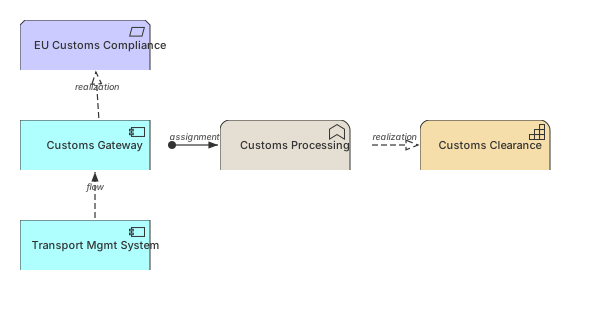 The Customs Gateway corner — component realizes requirement, component assigned to function, function realizes capability, flow from TMS.
View source model · Try it out ▶
The Customs Gateway corner — component realizes requirement, component assigned to function, function realizes capability, flow from TMS.
View source model · Try it out ▶
# Direct predicates (the diagram, literally)
:CustomsGateway am4:realizes :EUCustomsCompliance .
:CustomsGateway      am4:assignedTo :CustomsFunction .
:CustomsFunction     am4:realizes   :CustomsClearance .
:TMS                 am4:flowsTo    :CustomsGateway .

# The assignment promoted to a managed resource, because we want to record why and since when
:cg-assigned-customs-fn a am4:Assignment ;
    arch:source :CustomsGateway ;
    arch:target :CustomsFunction ;
    arch:lifecycleState "planned" ;
    dcterms:created "2025-06-27"^^xsd:date ;
    rdf:reifies <<( :CustomsGateway am4:assignedTo :CustomsFunction )>> .
A Cross-Domain View
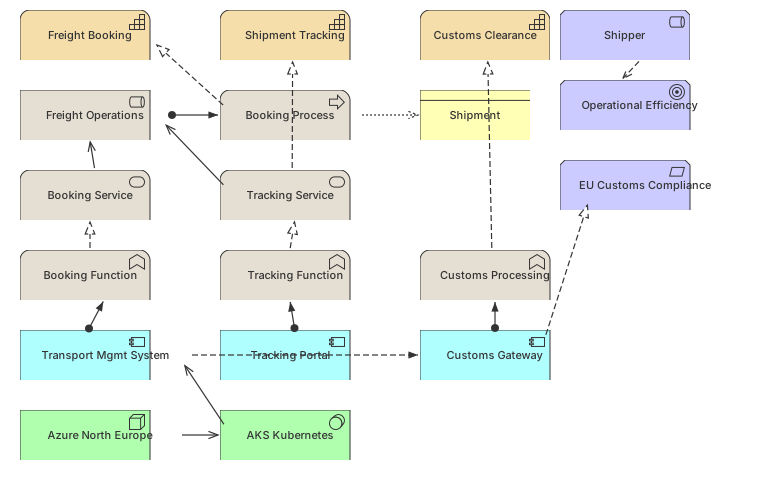 A cross-domain layered view spanning motivation, strategy, business, application, and technology.
View source model · Try it out ▶
A cross-domain layered view spanning motivation, strategy, business, application, and technology.
View source model · Try it out ▶
This view conforms to the Cross-Domain (Layered) viewpoint — we will make that conformance checkable in Part 5.
Layered View
A complete layered architecture view spanning motivation, strategy, business, application, and technology.
View source model · Try it out ▶
Part 3 — Validating the Model with SHACL
ArchiMate semantics that constrain a model live in SHACL, not OWL. This is deliberate: OWL works under the open-world assumption (a missing fact is merely unknown), whereas governance needs the closed-world opposite — "every application must have an owner" should be a checkable rule whose violation is an error, not an invitation to infer a missing owner. The manifest publishes three shape families, each answering a different question.
3.1 Element & Metamodel Validation (element-shapes)
Are the elements well-formed? The simplest shape requires every element to carry exactly one language-tagged label:
am4:ElementShape a sh:NodeShape ;
    sh:targetClass arch:Element ;
    sh:property [
        sh:path skos:prefLabel ;
        sh:minCount 1 ;
        sh:datatype rdf:langString ;
        sh:message "Every element must have at least one language-tagged skos:prefLabel."@en ;
    ] .
Passing: :TMS a am4:ApplicationComponent ; skos:prefLabel "Transport Management System"@en .
Failing, and the report it produces:
# Offending data
:Orphan a am4:ApplicationComponent .     # no prefLabel

# Validation result
[ a sh:ValidationResult ;
  sh:focusNode            :Orphan ;
  sh:resultPath           skos:prefLabel ;
  sh:sourceShape          am4:ElementShape ;
  sh:resultSeverity       sh:Violation ;
  sh:resultMessage        "Every element must have at least one language-tagged skos:prefLabel."@en ] .
3.2 Relationship-Validity Validation (shapes)
Is this edge legal? ArchiMate's relationship rules state which element types may connect via which relationship — the validity matrix in Appendix B of the specification. Linked.Archi generates SHACL from that matrix. For example, Assignment runs from an active-structure element to a behaviour element:
am4:AssignmentValidityShape a sh:NodeShape ;
    sh:targetSubjectsOf am4:assignedTo ;
    sh:property [
        sh:path am4:assignedTo ;
        sh:class am4:BehaviourElement ;        # target must be behaviour
        sh:message "Assignment target must be a Behaviour element."@en ;
    ] ;
    sh:class am4:ActiveStructureElement .       # source must be active structure
:FreightOperations am4:assignedTo :BookingProcess passes (Role → Process). The following fails, because a Data Object is passive structure, not behaviour:
:ShipmentData am4:assignedTo :BookingProcess .   # ✗ source is passive structure
# → sh:ValidationResult: "Assignment source must be an Active Structure element."
The complete Appendix B matrix — all 11 relationships against all element pairs — is published as SHACL in
archimate4-relationship-shapes.ttl. The shapes are generated directly from the specification's validity tables.
3.3 Principle Validation (principle-shapes)
Does the model satisfy our governance rules? This is where SHACL becomes architecture compliance as code — rules you run in CI/CD on every commit, not in a quarterly review. A common principle: every Application Component must have an owner.
am4:AppComponentOwnerPrinciple a sh:NodeShape ;
    sh:targetClass am4:ApplicationComponent ;
    sh:property [
        sh:path arch:owner ;
        sh:minCount 1 ;
        sh:severity sh:Violation ;
        sh:message "Every Application Component must declare an owner."@en ;
    ] .
Run against NordFreight as authored so far, :TMS, :TrackingPortal, and :CustomsGateway all fail — none has an owner. We will fix this in Part 7 without editing the ArchiMate model at all, by linking to the Backstage catalogue that already knows the owners.
3.4 Viewpoint Conformance (viewpoint-shapes)
Does this view show only what its viewpoint allows? A arch:View that declares conformance to a viewpoint can be checked against the element types that viewpoint permits — data-driven, reading the viewpoint definition from the graph. (See Part 5 for the viewpoint definitions this checks against.)
Running It
Run this to validate NordFreight against all shape families in one pass:
.scripts/validate.sh --shacl nordfreight-model.ttl \
    core/core-shapes.ttl \
    modelingLanguages/archimate/4.0/archimate4-element-shapes.ttl \
    modelingLanguages/archimate/4.0/archimate4-relationship-shapes.ttl \
    modelingLanguages/archimate/4.0/archimate4-principle-shapes.ttl
You now understand every file passed to it: element well-formedness, relationship legality, and governance principles, in one pass.
Part 4 — Deriving and Inferring New Facts with SPARQL Rules
A model states some relationships explicitly; many more are implied. ArchiMate's derivation rules say that a valid chain of relationships permits a derived relationship between its endpoints. In Linked.Archi these are sh:SPARQLRules, and every derived fact is annotated with provenance (PROV-O) and a confidence level — so inferred knowledge never silently masquerades as asserted knowledge.
One Derivation Rule
If an application component is assigned to a function, and that function realizes a capability, then the component realizes the capability:
am4:AssignRealizeDerivation a sh:NodeShape ;
    sh:rule [
        a sh:SPARQLRule ;
        sh:construct """
            PREFIX am4: <https://meta.linked.archi/archimate4/onto#>
            PREFIX prov: <http://www.w3.org/ns/prov#>
            PREFIX arch: <https://meta.linked.archi/core#>
            CONSTRUCT {
                ?comp am4:realizes ?cap .
                ?d a am4:Realization ;
                   arch:source ?comp ; arch:target ?cap ;
                   arch:confidence "derived" ;
                   prov:wasGeneratedBy am4:AssignRealizeDerivation ;
                   prov:wasDerivedFrom ?fn .
            }
            WHERE {
                ?comp am4:assignedTo ?fn .
                ?fn   am4:realizes ?cap .
                BIND(IRI(CONCAT(STR(?comp), "-realizes-", STRAFTER(STR(?cap), "#"))) AS ?d)
            }
        """ ;
    ] .
Before and After
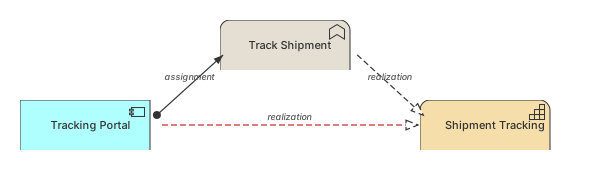 The red edge (Portal realizes Capability) is derived from the chain: Portal assigned to Function, Function realizes Capability.
View source model · Try it out ▶
The red edge (Portal realizes Capability) is derived from the chain: Portal assigned to Function, Function realizes Capability.
View source model · Try it out ▶
The derived edge is produced by the rule, carrying its lineage:
:TrackingPortal am4:realizes :ShipmentTracking .         # the derived triple

:TrackingPortal-realizes-ShipmentTracking a am4:Realization ;
    arch:source :TrackingPortal ;
    arch:target :ShipmentTracking ;
    arch:confidence "derived" ;
    prov:wasGeneratedBy am4:AssignRealizeDerivation ;
    prov:wasDerivedFrom :TrackShipment .
SPARQL Queries for Impact Analysis
A short SPARQL warm-up on the model:
# 1. List every Application Component
PREFIX am4: <https://meta.linked.archi/archimate4/onto#>
PREFIX skos: <http://www.w3.org/2004/02/skos/core#>
SELECT ?c ?label WHERE {
    ?c a am4:ApplicationComponent ; skos:prefLabel ?label .
}
# 2. Capabilities with no realizing behaviour (a gap-finder)
SELECT ?cap WHERE {
    ?cap a am4:Capability .
    FILTER NOT EXISTS { ?x am4:realizes ?cap }
}
# 3. Impact analysis — which capabilities ride on a given technology node?
#    Works over the DERIVED graph: AzureCloud serves K8s serves TMS assignedTo BookingFunction
#    realizes BookingService ... traversed transitively.
PREFIX am4: <https://meta.linked.archi/archimate4/onto#>
SELECT DISTINCT ?capability WHERE {
    :AzureCloud (am4:serves|am4:assignedTo|am4:composedOf|am4:realizes|am4:triggers)+ ?capability .
    ?capability a am4:Capability .
}
Query 3 is the home-page promise made literal: "what breaks if we retire this node?" becomes a property-path query rather than a week of manual tracing.
The derivation rules support two materialization strategies: eager (run all rules at load time) or lazy (derive on query, using SPARQL property paths). Eager gives fast reads but requires re-materialization on every model change; lazy has zero maintenance cost but slower queries on large graphs. The arch:confidence annotation ("derived" vs "asserted") ensures consumers can always distinguish inferred from authored facts regardless of strategy.
Materialized triples are written to a graph of their own, …/graph/derived, never into the semantic graphs. That is what lets a consumer exclude inferred content wholesale — for a count, a diff, or a validation run over asserted facts only — and it keeps re-derivation idempotent: clear the graph and re-run. See DD-28.
Part 5 — Viewpoints and Generating Presentations
A model is one source of truth; stakeholders need many tailored views of it. Linked.Archi separates viewpoints (the specification of a kind of view), presentation contexts (how a view is styled and filtered for an audience), and deliverable templates (SPARQL-driven documents) — all generated from the single model.
Viewpoints as First-Class Resources
A viewpoint is an arch:Viewpoint individual that names the element types it admits, the stakeholders it targets, and the concerns it frames:
am4vp:OrganizationViewpoint a arch:Viewpoint ;
    skos:prefLabel "Organization Viewpoint"@en ;
    arch:includesConcept am4:BusinessActor , am4:Role , am4:Collaboration , am4:BusinessInterface ;
    arch:targetsStakeholder am4vp:EnterpriseArchitect ;
    arch:viewpointFramesConcern am4vp:OrgStructureConcern ;
    arch:viewpointCoversAspect am4:ActiveStructureAspect ;
    arch:viewpointAddressesPerspective am4:OperationalPerspective .
A arch:View declares conformance to one viewpoint — and that conformance is exactly what the viewpoint-shapes from Part 3.4 check:
:NordFreightLayeredView a arch:View ;
    skos:prefLabel "NordFreight Cross-Domain View"@en ;
    arch:viewConformsToViewpoint am4vp:CrossDomainViewpoint .
Selected viewpoints (the full catalogue is the SKOS ViewpointCatalog):
| Viewpoint | Focus |
|---|---|
| Organization | Business actors, roles, collaborations |
| Application Structure | Application components, interfaces, data objects |
| Technology | Nodes, devices, system software, networks, equipment, facilities |
| Information Structure | Business objects, data objects, and their relationships |
| Process Cooperation | Processes, triggering, information exchange, supporting services |
| Service Realization | How services are realized by processes and active structure |
| Stakeholder | Stakeholders, drivers, assessments, goals, principles |
| Goal Realization | Goals refined into sub-goals and realized by requirements |
| Requirements Realization | Requirements realized by processes, components, services |
| Motivation | Full motivation structure (stakeholders through values) |
| Strategy | Resources, capabilities, value streams, courses of action |
| Capability Map | Capability hierarchy and composition |
| Outcome Realization | Outcomes realized by capabilities and core elements |
| Resource Map | Resources assigned to capabilities |
| Implementation and Deployment | Artifacts deployed on technology infrastructure |
| Migration | Baseline-to-target transition via plateaus and work packages |
| Cross-Domain (Layered) | Cross-domain traceability across all domains |
Presentation Contexts — One Model, Many Renderings
A presentation context is a "theme" — it selects appropriate visual notations, templates, and abstraction levels for a given stakeholder audience. Rather than creating separate models, you query the same knowledge graph through different lenses. Presentation contexts are a SKOS concept scheme; each concept names the audience and describes what they need:
am4pc:ExecutiveContext
    a skos:Concept ; skos:topConceptOf am4pc:ArchiMatePresentationContexts ;
    skos:prefLabel "Executive / C-Level"@en ;
    skos:definition "High-level overview with minimal technical detail. Focus on business capabilities, strategic alignment, cost, and risk."@en ;
    arch:usesNotationSet am4not:ArchiMate40StandardNotation ;
    skos:inScheme am4pc:ArchiMatePresentationContexts .

am4pc:OperationsContext
    a skos:Concept ; skos:topConceptOf am4pc:ArchiMatePresentationContexts ;
    skos:prefLabel "Operations / Infrastructure"@en ;
    skos:definition "Focus on technology domain and deployment. Nodes, devices, networks, environments."@en ;
    arch:usesNotationSet am4not:ArchiMate40StandardNotation ;
    skos:inScheme am4pc:ArchiMatePresentationContexts .
Both use the standard notation set out of the box. Organizations that want a simplified visual treatment for executives can define their own notation set (e.g. flat boxes without ArchiMate icons) and reference it via arch:usesNotationSet. The skos:definition text on each context drives tooling decisions about which viewpoints to apply and what level of detail to include.
 Same NordFreight model, two audiences — executives see capabilities and goals, tech-ops sees nodes and deployment.
Deliverable Templates — Model to Document
A deliverable template is a document structure whose sections are populated by SPARQL. The manifest ships three (Architecture Definition Document, Architecture Requirements Specification, Architecture Principles Document):
am4:ArchitectureDefinitionDocument a arch:DeliverableTemplate ;
    skos:prefLabel "Architecture Definition Document"@en ;
    arch:hasSection [
        skos:prefLabel "Application Portfolio"@en ;
        arch:populatedBy """
            SELECT ?c ?label WHERE {
                ?c a am4:ApplicationComponent ; skos:prefLabel ?label .
            } ORDER BY ?label
        """ ;
    ] .
Run the toolbox generator over NordFreight and the Application Portfolio section materializes as Markdown:
The generator itself lives in the toolbox repository; see the Deliverable Generator Spec.
Part 6 — Tailoring and Extending the Language
The semantic assets are raw material, not a sealed package. Tailoring means adding resources the manifest already knows how to aggregate — never forking the language.
Add a Custom Element Type
Suppose NordFreight wants to single out regulatory integration points. Define :RegulatoryGateway as a subclass of am4:ApplicationComponent, register it for navigation, and constrain it — touching several assets coherently:
# onto — the class
:RegulatoryGateway a owl:Class ;
    rdfs:subClassOf am4:ApplicationComponent ;
    arch:isAbstractClass false ;
    skos:prefLabel "Regulatory Gateway"@en ;
    skos:definition "An application component that integrates with an external regulatory authority."@en .

# tax — so palettes and filters pick it up
:RegulatoryGatewayConcept a skos:Concept ;
    skos:prefLabel "Regulatory Gateway"@en ;
    skos:broader am4:ApplicationDomain , am4:ActiveStructureAspect ;
    rdfs:seeAlso :RegulatoryGateway .

# shapes — a tailored governance rule
:RegulatoryGatewayShape a sh:NodeShape ;
    sh:targetClass :RegulatoryGateway ;
    sh:property [
        sh:path am4:influences ;
        sh:minCount 1 ;
        sh:message "A Regulatory Gateway must be influenced by at least one Requirement."@en ;
    ] .
Now reclassify the Customs Gateway:
Because of rdfs:subClassOf, everything already written for am4:ApplicationComponent still applies — the owner principle (Part 3.3), the serving derivation (Part 4), the queries (Part 4), and the Application Structure viewpoint all continue to see :CustomsGateway, with no changes. That is the payoff of monotonic subsumption.
Compose with Extensions
Cross-cutting extensions import arch:core, so they attach to ArchiMate elements with no integration code. Record why the Customs Gateway pattern was chosen, and how the legacy TMS scores in portfolio terms:
@prefix ad:     <https://meta.linked.archi/arch-decision#> .
@prefix timefw: <https://meta.linked.archi/time-framework/onto#> .

:UseDedicatedCustomsGateway a ad:Decision ;
    skos:prefLabel "Use a dedicated Customs Gateway"@en ;
    ad:addresses :EUCustomsCompliance ;
    ad:affects   :CustomsGateway ;
    ad:status    "accepted" .

:TMSFitAssessment a timefw:FitAssessment ;
    timefw:assesses :TMS ;
    timefw:functionalFit "low" ;
    timefw:technicalFit  "low" ;
    timefw:classifiedAs  timefw:Migrate .   # → flagged for migration
Custom viewpoints, custom relationships (full three-declaration), and organization-specific notation follow the same patterns shown above — subclass existing types, register in the taxonomy, and constrain with SHACL. See Build Your Own Metamodel for the full workflow.
Part 7 — Linking with Other Notations and Frameworks
Because every Linked.Archi language imports arch:core, an ArchiMate ApplicationComponent, a C4 Container, and a Backstage Component are all arch:Element instances. They coexist in one graph, share SHACL shapes, and answer the same SPARQL queries.
 All languages import arch:core, enabling cross-notation linking in one graph.
A Concrete Link: ArchiMate ↔ Backstage
NordFreight's running estate is catalogued in Backstage, which knows ownership and lifecycle that the ArchiMate model does not. Link the two representations of the same system:
@prefix bs: <https://meta.linked.archi/backstage/onto#> .

# The Backstage catalog entry, with the owner ArchiMate lacked
bs:tracking-portal a bs:Component ;
    bs:name "tracking-portal" ;
    skos:prefLabel "tracking-portal"@en ;
    bs:lifecycleState bs:Production ;
    arch:owner "team-shipment-tracking" .

# Establish that these two nodes describe the same real-world system.
# skos:exactMatch, not owl:sameAs — the two models describe this system at
# different granularities, so the substitutability test fails. See DD-11.
:TrackingPortal skos:exactMatch bs:tracking-portal .
Now ask a question no single tool could answer — and re-run the owner principle from Part 3.3:
# Which ArchiMate Application Components lack an owner, even after consulting Backstage?
PREFIX am4: <https://meta.linked.archi/archimate4/onto#>
PREFIX arch: <https://meta.linked.archi/core#>
PREFIX skos: <http://www.w3.org/2004/02/skos/core#>
SELECT ?c WHERE {
    ?c a am4:ApplicationComponent .
    FILTER NOT EXISTS { ?c arch:owner ?own }
    FILTER NOT EXISTS {
        ?c (skos:exactMatch|^skos:exactMatch) ?corresponding .
        ?corresponding arch:owner ?ownerViaCorrespondence .
    }
}
:TrackingPortal no longer appears: it carries no arch:owner of its own, but the
correspondence reaches one. The governance gap was closed by linking, not by re-modelling.
(:TMS and :CustomsGateway remain flagged until they too are catalogued.)
That second FILTER NOT EXISTS is the cost of correspondence over merge, and it is worth
understanding rather than working around. skos:exactMatch carries no OWL entailment, so
nothing is inherited — the query crosses the link itself, one hop, written explicitly, with no
reasoner in the everyday path. owl:sameAs would let a reasoner pool both nodes' properties
and the shorter two-line query would pass unchanged; it also asserts the two IRIs denote one
individual, which silently corrupts every downstream query if that turns out to be wrong.
Choose with the substitutability test: if a reasoner could safely replace one IRI with the
other everywhere, forever, the nodes are one entity → owl:sameAs. Otherwise →
skos:exactMatch. A Backstage component and an ArchiMate component describe the same system
at different granularities and for different concerns, so this pairing is a correspondence,
not an identity. See DD-11
for the full rationale and for where reviewed identity links are recorded.
Why the property path runs both ways
skos:exactMatch is symmetric by definition, but symmetry is an entailment — without a
reasoner, only the direction actually written is present in the data. (skos:exactMatch|^skos:exactMatch)
is how a reasoner-free query stays correct whichever way the link was authored.
Other Pairings, in Brief
- ArchiMate ↔ C4 — map an
am4:ApplicationComponentto a C4Containerfor developer-facing zoom-in. See Application Layer vs C4 Containers. - ArchiMate ↔ BPMN — drill a single
am4:Processdown into an executable BPMN flow when order, gateways, and exceptions matter. - ArchiMate ↔ TOGAF — cross-map elements to the TOGAF content metamodel so a NordFreight element participates in an ADM deliverable. See the TOGAF Modelling Guide.
Cross-mapping happens at two levels, and they use different mechanisms:
| Level | What it relates | Mechanism | Where it is authored |
|---|---|---|---|
| Instance | this ArchiMate component ↔ that Backstage component | skos:exactMatch by default; owl:sameAs for the documented subset where identity is confirmed and a property merge is wanted |
reviewed by hand, recorded in the reconciliation graph |
| Type | am4:ApplicationComponent ↔ togaf:LogicalApplicationComponent |
skos:closeMatch, skos:relatedMatch, skos:broadMatch, skos:narrowMatch — skos:exactMatch only where the two genuinely coincide in scope |
a metamodel's cross-language mapping document |
Neither is produced by a converter: mappings are editorial judgements, not derivations. Instance
links are authored and reviewed per
DD-11; type-level
mappings live in a *-crossmappings.ttl registered on the metamodel via arch:crossLanguageMappings
— see Authoring cross-language mappings. Cross-boundary SPARQL
queries traverse the link explicitly, regardless of which notation originated each element.
Where to Go Next
You have now exercised every capability of ArchiMate 4.0 in Linked.Archi, each once: you read the language, authored a model, validated it three ways, derived new facts with provenance, rendered it for two audiences and a document, tailored it with a custom type and two extensions, and linked it to another notation. Re-reading the manifest map, every node is now lit.
Two things worth remembering. First, you never have to write SPARQL by hand: the Linked.Archi MCP server exposes this whole graph to AI agents, so a natural-language question ("what breaks if we retire Azure North Europe?") is translated to the query in Part 4 and answered against your real model. Second, every topic introduced here has a dedicated deep-dive article — the Relationship Modelling Guide, the Validation Guide, and the Design Decisions expand on the patterns shown above.
Further Reading
- ArchiMate 3.2 Modelling Guide — detailed analysis of the 3.2 ontology
- ArchiMate 3.2 vs 4.0 — migration guide between versions
- ArchiMate Design Decisions — rationale for ontology design choices
- Modelling Languages Guide — how ArchiMate relates to other languages
- Relationship Modelling Guide — the three-declaration pattern in depth
- Build Your Own Modelling Tool — how tools consume these assets
- Validation Guide — SHACL validation pipeline
- Deliverable Generator Spec — how templates become documents
- ArchiMate 4.0 Metamodel Manifest — the live index of every asset used here
- Architecture & Approach — the core thesis and the OWL / SHACL / SKOS division of labour
- Domain & Range Guide — why
domainIncludes/rangeIncludes, notrdfs:domain/rdfs:range - ArchiMate 4.0 Specification — the official spec by The Open Group
- The Open Group ArchiMate Forum — community and certification
Disclaimer: This is a community semantic representation of ArchiMate for interoperability purposes. It is not produced by, endorsed by, or affiliated with The Open Group. "ArchiMate" is a registered trademark of The Open Group.